Skip to content
LincolnDoor & Opener Co.Open 24/7 (289) 432-1344
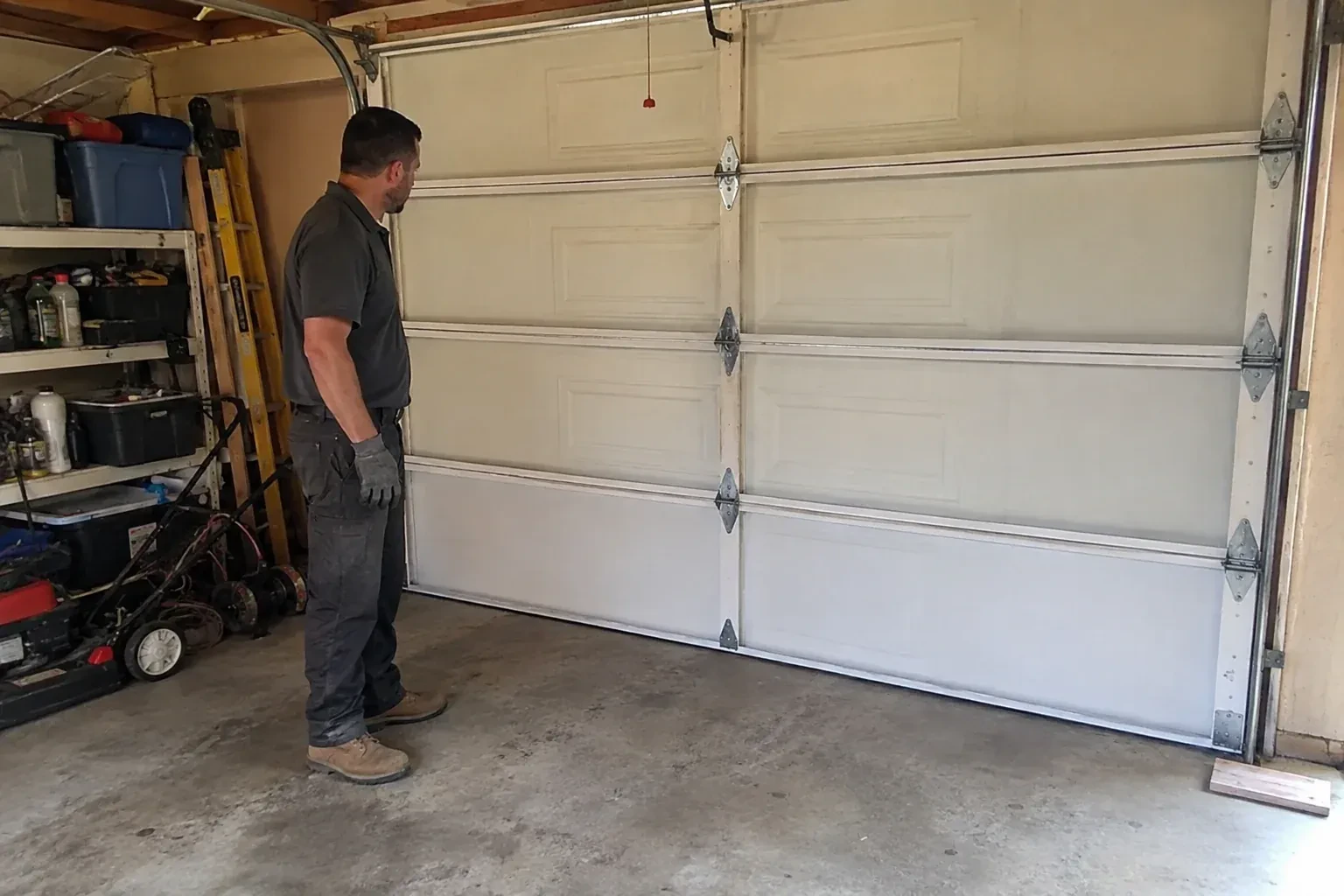
A person examines the interior panels and hinges of a closed sectional garage door. — Garage Door Panel Replacement, Lincoln

Repairs · Lincoln

Garage Door Panel Replacement

Rust has crept along the bottom edge of the lowest section. What began as bubbling paint is now a soft, flaking strip, the seal retainer is working loose, and a screwdriver pressed against the worst spot goes through the steel.
In plain words

Not all sections are equal. The bottom section carries the brackets that anchor the lift cables, the seal that meets the floor, and most of the abuse from ice, salt and bumpers. The top section takes the pull of the opener arm and often carries a strut. The intermediate sections mostly carry hinges and rollers. Which position is damaged shapes the whole job: a bottom section means releasing spring tension before the brackets come off, a top section means dealing with the opener bracket and top fixtures, and a middle section is the most straightforward exchange. The technician plans the visit around that position.

Sound familiar?Lincoln

The call
Rust has crept along the bottom edge of the lowest section. What began as bubbling paint is now a soft, flaking strip, the seal retainer is working loose, and a screwdriver pressed against the worst spot goes through the steel.

NextHow the visit goes

Garage Door Panel Replacement · Lincoln

How the visit goes

Illustrative garage doors scene
  1. Scene 1

    Mapping the damage on the section

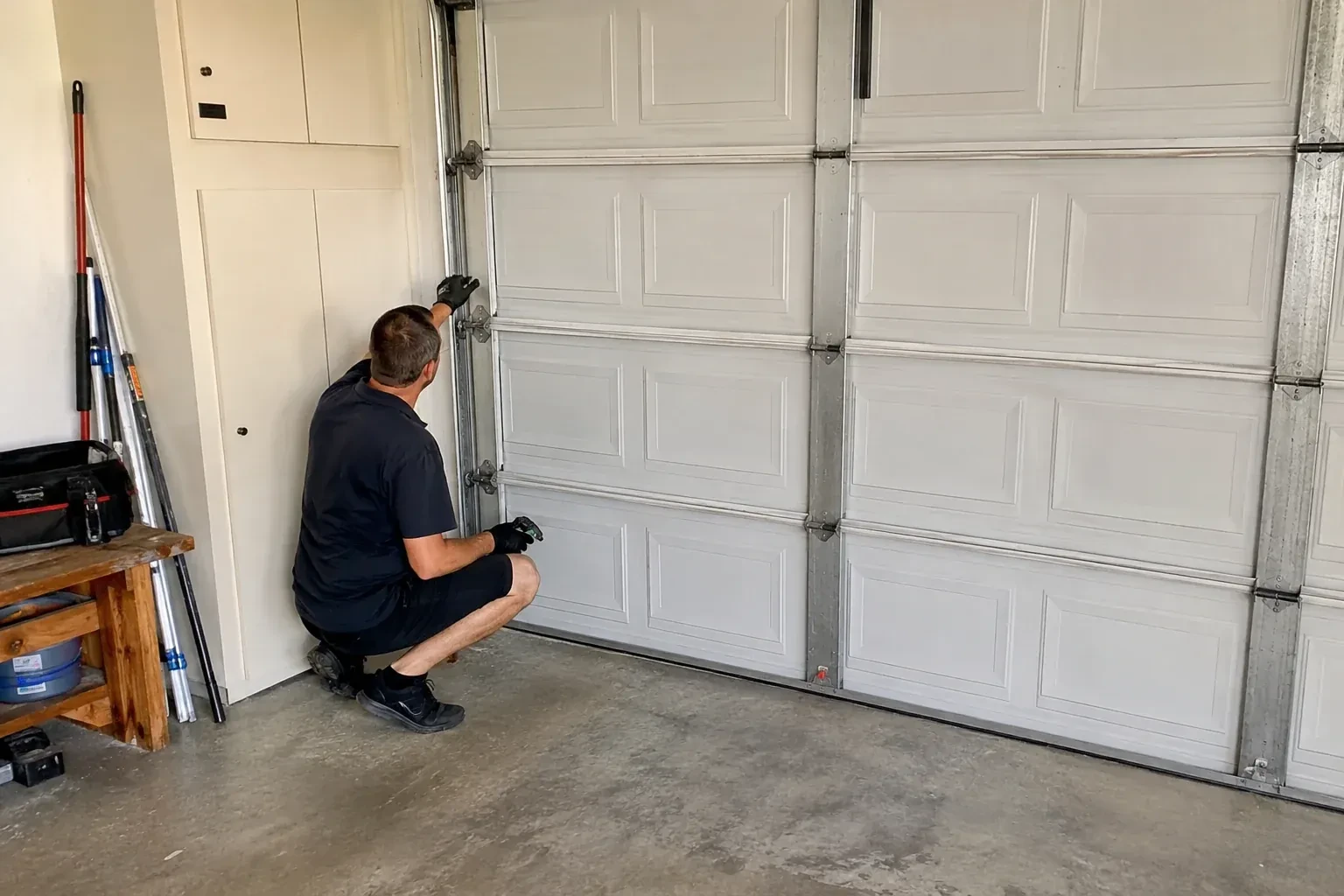
    Where a dent sits matters as much as its size. A shallow dish in the middle of the skin is one thing; a crease that runs to the joint, a fold at an end stile, or a bend through a hinge point is another, because those areas carry the door's load as it moves. The technician records the depth of the damage, whether the inner skin or backer is affected, whether a strut has kinked and whether the section still lies flat when the door is closed. That map decides between working the dent out, replacing the single section, or looking harder at the rest of the door.

  2. Scene 2

    Releasing tension for a bottom section

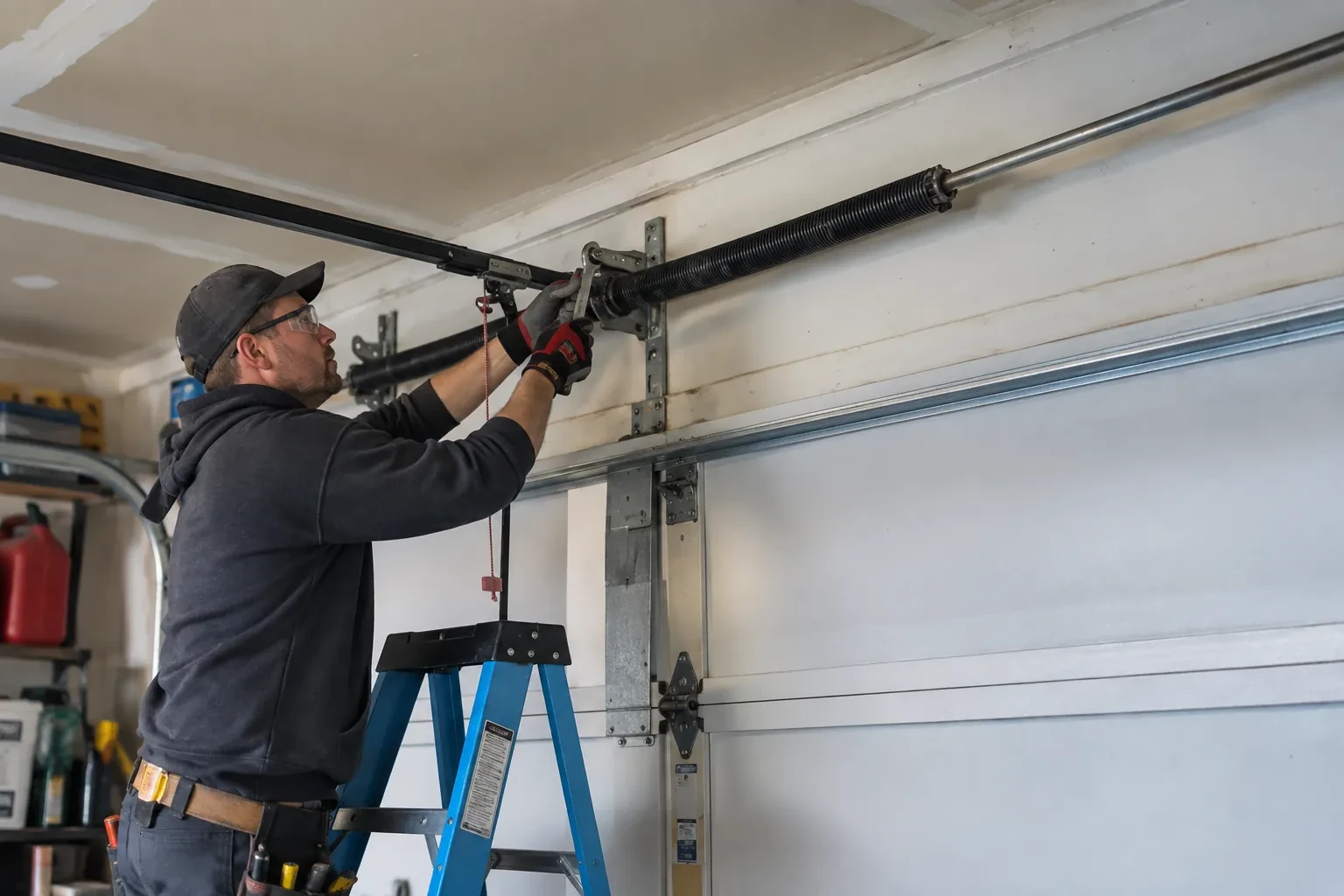
    The bottom section is the one place where the lift cables attach, and those cables are held taut by the springs. Before its brackets are unbolted, the technician takes the energy out of the system. On a torsion door that means fitting winding bars into the cone and unwinding the spring turn by turn while the set screws are loosened; on an extension-spring door it means propping the door open and unhooking the springs. With the cables slack, the bottom brackets, the seal retainer and the section itself can be removed safely. The same steps are reversed at the end, and the door's balance is set fresh.

  3. Scene 3

    A record of the door for next time

    You leave with the door's identity written down: manufacturer, model or series, section height and thickness, panel design, colour code and the position of the section that was replaced. Keep it with the house papers or photograph it and file it on your phone. The next time a section, a hinge or a set of rollers is needed, that record turns a search into a straightforward order. It also tells any future technician what has already been changed and when, which helps them judge the rest of the door's age and condition without guessing.

In the van

  • Matching replacement section
  • Numbered section hinges
  • Adjustable top roller brackets
  • Horizontal reinforcement strut
  • Nylon or steel rollers

What shapes the quoteLincoln Door & Opener Co.

Opener adjustments afterwards
Resetting the opener's limits and force and testing the safety reversal is part of finishing the job. Where the opener arm bracket or a worn trolley needs replacing as well, that hardware is listed.
A make-safe visit while the section is on order
When the door has to be braced, disconnected or secured closed until the section arrives, that first visit is quoted as its own item, with the installation visit following once the part is in.
Access and working room
A section is wider than the door opening and is carried in and manoeuvred by two people. A cluttered garage, a low ceiling around the spring, or a tight driveway adds handling time.

FeesSame any hour

Have it ready

Before you call · 0 / 3

(289) 432-1344

Answers in plain language

Why is the bottom section handled differently from the others?

The bottom section is where the lift cables attach, through the bottom brackets at each end, and those cables are under the full pull of the springs. Before the brackets come off, the springs have to be unwound or unhooked so the cables go slack. The bottom section also carries the seal retainer and astragal that meet the floor. After the new section is in, the springs are re-tensioned and the balance reset.

Why do bottom sections get damaged so often in winter?

Meltwater runs under the bottom seal during a thaw and freezes the door to the slab overnight. When the opener starts in the morning, it pulls on a door that is anchored at the bottom, and something yields: the section bows, a hinge tears from its stile or a cable jumps. Salt and slush thrown off the car then corrode the lower edge. Keeping the seal free of ice and rinsing salt away protects the new section.

Can a wood garage door section be replaced?

Yes, though wood doors are more often site-built or made in small runs, so a matching section may be made up by a door shop rather than ordered from a catalogue. The new section is primed and finished to match, the hardware is transferred, and the technician looks closely at the neighbouring sections for rot or splitting, since wood sections tend to age together. Where several are failing, a new door is discussed.

Lincolninformation

NiagaraOntario

Garage Door Panel Replacement · Beamsville, Vineland, Campden, Wellandport

Town
Lincoln, Niagara
In business
22 years
Hours
Open 24/7
Nights, weekends and holidays, same fees
Visits
On-site assessment preferred. Request a visit or call.

2021 census: what it means at the door

Every square is one home in a hundred.

  • 41 in 100 homes · mixed ages
  • About 41% of homes in Lincoln were built in 1980 or earlier, according to the 2021 Census.A mixed housing stock means some doors are on their original openers without photo-eyes while others have modern units with apps and keypads. We handle both: upgrading the older ones for safety and quietness and adjusting or expanding the newer ones as the household grows.
  • Single-detached houses make up about 70% of homes in Lincoln (2021 Census).Family homes with their own garage tend to use it as the everyday entrance, so the door sees many cycles a week and the auto-reverse and photo-eyes matter for children and pets. We test both on every visit and set the force so the door stops on a light touch.

Source: Statistics Canada, Census Profile

Open Lincoln in Google Maps

On-site assessment

Request a visit.

Rust has crept along the bottom edge of the lowest section.

(289) 432-1344, open 24/7.